What to Do After a Truck Accident in Grand Forks
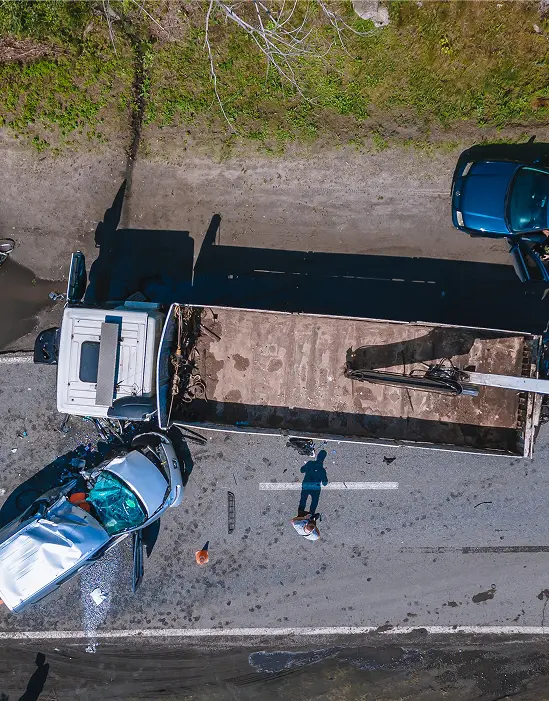
The minutes after a truck crash are chaotic, and what you do in them can shape your entire claim. Make sure that someone calls 911 first. It’s important to get medical attention, even if you feel okay, because the adrenaline masking your pain right now wears off in a few hours and the symptoms that follow can be the serious ones.
Then, document everything you can. If you are able, photograph the vehicles, the road, the skid marks, the cargo, and the markings on the truck and trailer. Get the driver’s name, the trucking company’s name, and the USDOT number painted on the cab. Talk to witnesses and write down what they saw.
Here is the part most people do not know. A truck accident is not simply a bigger car accident. The trucking company’s insurer and its rapid-response team are often working the scene within hours, sometimes before you have left the hospital. Their job is to get ahead of your claim. The truck’s electronic control module, often called the black box, holds data on speed, braking, and hours driven, and that data can be overwritten or lost if no one moves to preserve it.
This is why you should talk to a Grand Forks truck accident lawyer before you give a statement to the trucking company’s insurer. Do not sign anything, and don’t agree to make a recorded statement. An attorney can send a spoliation letter that legally requires the company to preserve the black box data, the driver’s logs, and the maintenance records before any of it disappears. We step in early so the evidence that proves your case is still there when we need it.
Who Can Be Held Liable in a North Dakota Truck Accident?
In a typical car crash, it’s typical to only have to deal with one at-fault driver and one insurance policy. Truck cases are different, and fortunately, that difference often works in your favor.
A single semi crash can involve several responsible parties, including:
- The driver, if they were fatigued, distracted, impaired, or driving carelessly.
- The trucking company, which can be liable for the driver’s conduct on the job, and directly liable for negligent hiring, inadequate training, or pushing unrealistic delivery schedules that encourage drivers to break the rules.
- The cargo loader, when freight was overloaded, unbalanced, or improperly secured, and that caused the truck to jackknife or roll.
- The maintenance contractor, if worn brakes, bald tires, or a mechanical failure they were responsible for played a role.
- The parts manufacturer, if a defective component failed.
Sorting out trucking company liability in North Dakota takes investigation, because the parties involved often point fingers at each other to avoid paying. More defendants can also mean more available insurance coverage, which matters when injuries are severe and one policy would never be enough. A North Dakota commercial vehicle accident attorney who knows how to trace responsibility across all of these parties can find sources of compensation you would never uncover on your own.
FMCSA Regulations and How Violations Affect Your Claim
Commercial trucks operate under a federal rulebook that ordinary drivers never have to worry about: the Federal Motor Carrier Safety Regulations, enforced by the Federal Motor Carrier Safety Administration. When a carrier or driver breaks one of these rules, the violation can become powerful evidence of negligence in your case.
Here’s what you need to know:
- Part 395 governs hours of service, limiting how long a driver can stay behind the wheel.
- Part 382 sets out drug and alcohol testing requirements for commercial drivers.
- Part 396 covers vehicle inspection, repair, and maintenance, requiring carriers to keep their trucks roadworthy and to document that they did.
When we pursue an FMCSA violations truck accident claim, we are not just arguing that a driver was reckless. We are also showing that a federal safety standard existed via the FMCSA, that it was broken, and that breaking it led to your injuries.
Hours of Service Violations and Driver Fatigue
Fatigue is one of the most common and most dangerous causes of truck crashes. Unfortunately, when profit is on the line, unscrupulous commercial trucking companies will coerce their drivers into staying on the road far longer than is safe. That’s why there are rules about it. The government recognizes that without regulation, drivers may feel pressured to stay on the road as long as possible.
Under Part 395 of the FMCSA Hours of Service regulations, a property-carrying commercial driver generally may drive no more than 11 hours after 10 consecutive hours off duty and may not drive beyond the 14th consecutive hour after coming on duty. Drivers must also take a 30-minute break after 8 cumulative hours of driving without a qualifying interruption. Weekly limits also apply: drivers may not drive after 60 hours on duty in 7 consecutive days or 70 hours in 8 consecutive days, depending on whether the carrier operates every day of the week
Electronic logging devices are supposed to track this, but logs can be falsified or manipulated. We cross-check the ELD records against fuel receipts, weigh station data, GPS, and delivery timestamps to expose the gap between what the logbook says and what actually happened. That gap is often where the case is won.
Common Truck Accident Injuries and Their Long-Term Impact
A fully loaded semi can weigh 80,000 pounds, but a passenger car only weighs around 4,000. When those two collide, the physical reality of the crash leads to serious injuries.
The injuries we see most often in these cases include:
- Traumatic brain injuries and concussions
- Spinal cord damage, including partial and complete paralysis
- Multiple fractures and crush injuries
- Internal organ damage and internal bleeding
- Severe burns
- Amputations
You can’t walk away from injuries like this with just a few weeks off work. Many of these conditions require multiple surgeries, months of rehab, and care that stretches years (or maybe even a lifetime) into the future. After a truck accident, you may not be able to work the same job anymore, or you may not be able to work at all. You still need to be able to live your life.
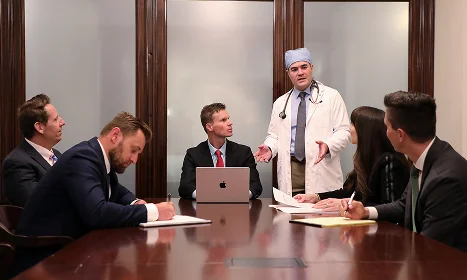
This is where having Dr. Andrew Georgi on our team changes the outcome. Dr. Georgi is our Medical Director, a full-time member of the firm rather than an outside expert we phone when we need one. Before joining us, he spent his career as an anesthesiologist and assisted in more than 10,000 surgeries.
He evaluates your injuries directly, identifies complications that are not obvious in the first days after a crash, and maps out what your medical future actually looks like. When an insurer tries to argue your injuries are not that bad, Dr. Georgi’s assessment is hard evidence of what really happened. That medical credibility, built in from day one, is one reason our clients recover what they are genuinely owed.
How Much Is a Truck Accident Settlement Worth in North Dakota?
No two truck accidents are the same, so it’s not possible to give an accurate estimate of the value of your case without knowing the details. Compensation is based upon factors like the severity of your injuries, your ability to work and live after the crash, and how much insurance coverage is available across all responsible parties.
A North Dakota truck accident settlement usually accounts for two kinds of damages.
- Economic damages, which cover the costs you can put a firm number on. This includes medical care, ongoing treatment, lost wages, and reduced earning capacity.
- Non-economic damages, which cover the losses that are harder to quantify but still very real. This includes pain, suffering, disfigurement, scarring, and permanent changes to your activities and relationships.
Truck settlements tend to be larger than car accident settlements because:
- the injuries are usually more severe
- commercial insurance policies behind the truck are far larger than a personal auto policy
- multiple layers of liability open more avenues for recovery.
None of that money comes automatically. It comes from documenting every loss thoroughly and refusing to accept the first lowball offer the insurer puts on the table.
North Dakota Truck Accident Laws and Statute of Limitations
Two North Dakota laws shape almost every truck accident case, and understanding them early protects you.
Under N.D. Cent. Code § 28-01-16, you generally have six years from the date of injury to file a personal injury lawsuit. That is one of the most generous windows in the country, but it is not a reason to wait. If you wait, you’re giving evidence the opportunity to degrade and witnesses the chance to forget what they saw. The sooner an attorney can act, the stronger your case will be.
Note that if your claim is against a government entity in North Dakota, the timeline is shorter. You have to present a claim against the state to the Office of Management and Budget within 180 days. If the truck, driver, manufacturer, or municipality that caused your accident is a representative of the state, you need to take action right away.
Second, fault. North Dakota follows modified comparative fault under N.D. Cent. Code § 32-03.2-02. You can recover damages as long as you were less than 50 percent responsible for the crash, but your award is reduced by your share of the blame. If you are found 20% at fault on a $500,000 claim, you receive $400,000, which is a reduction of 20%.
This rule often prompts insurers to try as hard as possible to pin more of the blame on you, trying to reduce their share of the burden. We counter that by building a factual record of what happened, keeping responsibility where it belongs.
Grand Forks Truck Accident Statistics and Freight Corridors
Grand Forks sits at the crossing of two heavily traveled freight routes, causing a lot of the truck accidents we see.
Interstate 29 is the primary north-south freight corridor through the Dakotas. It is designated as a high-priority and international trade route that carries truck traffic all the way up to the Canadian border at Pembina and down toward Fargo and Sioux Falls. The volume is constant, and the speeds are high.
US Highway 2 is the major east-west route, crossing the state and meeting I-29 right at Grand Forks. The interchange where these two corridors meet concentrates commercial traffic and creates the kind of merging, high-speed conditions where serious truck crashes happen.
Then there is the weather. North Dakota winters bring ice, blowing snow, and sudden whiteouts. Summer hail and thunderstorms can reduce visibility to zero. Dust storms that blow in can make it impossible for truck and car drivers to see what they need to see. A truck driver must know how to handle these challenges and safely eliminate risks to other drivers, possibly by pulling over and waiting until the rain or dust has passed.
The state has invested in systems like variable speed limits and incident detection along I-29 specifically because of how often weather and freight density combine into crashes here.
A Grand Forks semi truck accident lawyer who knows these roads, these conditions, and how local crashes actually unfold brings something a distant firm cannot. We know this terrain because it is ours. If you were hurt in a commercial truck crash anywhere in or around Grand Forks, let us carry the legal fight so you can put your attention where it belongs, on getting better.
FAQs about Truck Accident Cases in Grand Forks
What makes truck accidents more dangerous than car accidents?
Truck accidents often involve larger vehicles, heavier loads, and higher impact forces, which can lead to more severe injuries. In addition, commercial trucks are subject to federal safety regulations, and violations of those rules can play a major role in how a claim is handled.
Who can be held responsible for a truck accident?
Responsibility is not always limited to the driver. Liability can extend to the trucking company, a maintenance provider, or even a cargo loading company. Identifying all responsible parties is important because it can affect how much compensation is available.
When should I contact a truck accident lawyer?
It is best to speak with a lawyer as soon as possible after the accident. Trucking companies often begin investigating immediately, and key evidence such as driver logs or maintenance records can be lost or altered over time. Early legal guidance can help protect your claim and keep the process on track.